Buyer’s Guide
Pharmaceutical Packaging Machines: Requirements and Standards
Short answer
Pharmaceutical packaging machines must dose or count accurately, protect the medicine from contamination, moisture and light, print correct batch and expiry information on every pack, and be cleanable and documented well enough to be qualified under Good Manufacturing Practice (GMP). In Pakistan, pharmaceutical manufacturers are licensed and inspected by the Drug Regulatory Authority of Pakistan (DRAP), so packaging equipment has to fit into the GMP system your plant already runs.
This article explains the main requirements in practical terms, for production managers and engineers specifying new equipment. It is general guidance, not regulatory advice: always confirm current requirements with DRAP and your own quality assurance team.
Primary and secondary packaging
Primary packaging touches the medicine: blisters, strips, sachets, bottles, tubes, vials and ampoules. It protects the product and is part of its stability profile, so changes to primary packaging can affect registration. Secondary packaging holds primary packs: cartons, leaflets, labels and shrink-wrapped bundles. It carries information and protects packs in transport. The requirements below apply most strictly to primary packaging machines, but traceability requirements apply to both.
1. Accurate dosing and counting
Every unit must contain the right dose. For solid dosage forms that means every blister cavity or strip pocket is filled with one intact tablet or capsule; for powders, liquids and semi-solids it means fill weights or volumes stay within tight limits batch after batch.
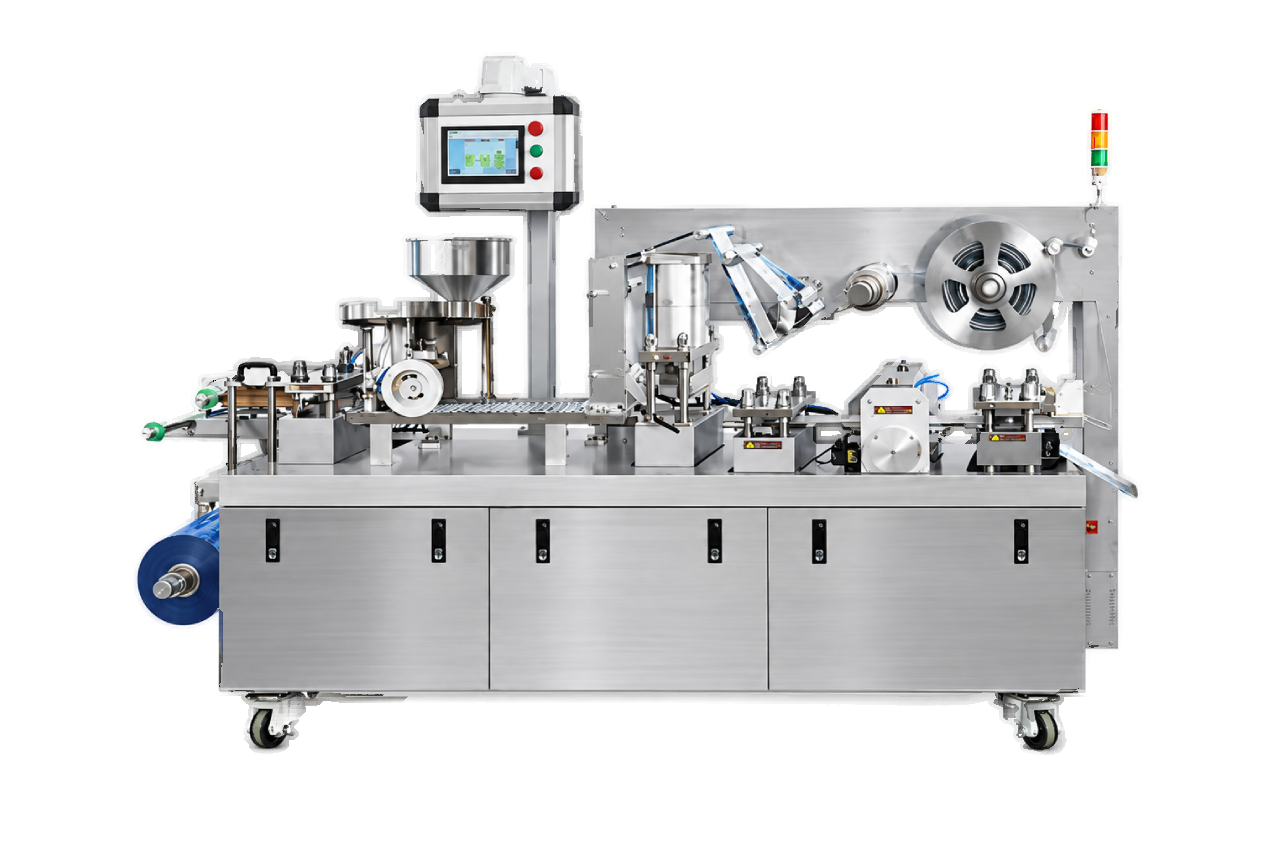
- Blister and strip packing machines need reliable feeding so cavities are not left empty or double-filled.
- Sachet powder machines need consistent dosing of small fills, often under 20 g.
- Syrup fillers commonly use piston filling for repeatable volumes.
- Capsule filling machines need consistent fill weight per capsule.
Ask how accuracy is measured, how often samples should be checked during a run, and what the machine does when a fault is detected.
2. Protecting the product
Packaging must keep moisture, oxygen and light away from the medicine for its whole shelf life. For tablets and capsules this is mainly a choice of blister material:
- Alu-Alu (cold-form aluminium): an almost complete barrier to moisture and light, used for sensitive products.
- Alu-PVC: transparent, lower cost, with a lower moisture barrier. Coated PVC films give intermediate protection.
- Strip packs: tablets sealed between two layers of foil or laminate, a common retail format.
The right choice comes from your product’s stability data. The packaging machine must then be set up for that material, since forming, sealing temperatures and tooling differ between them.
3. Hygienic design and materials
Pharmaceutical equipment should be easy to clean and inspect, and should not add anything to the product. In practice, buyers commonly look for:
- Stainless steel for product-contact parts, with smooth, polished surfaces
- No crevices, dead spots or exposed threads where product can collect
- Product-contact parts that can be removed for cleaning without special tools
- Lubricated parts kept away from the product path, or suitable lubricants where contact is possible
- Guarding that keeps dust and operators’ hands away from open product
Ask your supplier which materials touch the product and whether material certificates are available for those parts.
4. Cleaning, changeover and line clearance
Mix-ups between products or batches are one of the most serious packaging errors. GMP requires line clearance between batches: removing all product, packaging materials and printed items from the previous batch before the next one starts, and checking that this has been done. Machines that are easy to empty, clean and inspect make line clearance faster and more reliable.
If you run many products, changeover time also affects capacity. Ask which change parts are needed for each product, how long a changeover takes, and how parts are identified so the wrong tooling is not fitted.
5. Batch coding, labelling and traceability
Every pack must carry the correct batch number, manufacturing date and expiry date, and the information must be legible for the product’s whole life. This is done by labelling and coding machines — an automatic labeling machine for bottles, cartons or blister strips, and coding units that print directly on foil, cartons or labels.
Many plants add checks that every code is present and readable. Barcode and track-and-trace expectations for medicines have been evolving, so check DRAP’s current requirements for your products and markets when specifying a coding system.
6. Qualification and documentation
Under GMP, equipment is formally qualified before it is used for production. The usual sequence is:
- User Requirement Specification (URS): your written statement of what the machine must do.
- Design Qualification (DQ): confirming the proposed design meets the URS.
- Factory and Site Acceptance Tests (FAT/SAT): testing the machine before and after delivery.
- Installation Qualification (IQ): confirming it is installed correctly, with utilities connected as specified.
- Operational Qualification (OQ): confirming it operates as intended across its working range.
- Performance Qualification (PQ): confirming it consistently produces acceptable packs with your product.
Your QA team owns this process, but the supplier provides much of the input: drawings, material information, manuals, spare parts lists and test records. Agree what documentation will be supplied before you order.
7. The production environment
Most tablet, capsule and liquid packaging takes place in controlled areas with managed temperature, humidity and cleanliness. Sterile products are different: injectable filling and stoppering machines must be integrated into classified cleanroom conditions, and their compliance requirements should be agreed in detail before the machine is specified.
If you export, your customers may also expect compliance with WHO GMP guidance or the rules of their own regulators, including requirements for electronic records on machines that store production data.
8. Maintenance and reliability
Breakdowns on a pharma line are costly because a stopped batch may need investigation before it can be released. Plan preventive maintenance, keep critical spare parts in stock and record all maintenance work. Our packaging machine maintenance checklist and after-sales service page cover this.
Checklist: questions to ask a pharma packaging machine supplier
- Which materials touch the product, and are certificates available?
- How is dosing or counting accuracy measured and controlled?
- Which packaging materials has the machine been set up for?
- How long does cleaning and changeover take?
- How are batch and expiry codes applied and checked?
- Which documents are supplied to support IQ, OQ and PQ?
- Which spare parts should be kept in stock, and how quickly is service available?
Maxim Machines supplies a full range of pharma packaging machines, from blister and strip packing to filling, labelling and cartoning, and we discuss your compliance requirements before specifying any machine.
This article is general guidance, not regulatory advice. Confirm current requirements with DRAP and your quality assurance team.
Frequently Asked Questions
Who regulates pharmaceutical manufacturing in Pakistan?
The Drug Regulatory Authority of Pakistan (DRAP) licenses and inspects pharmaceutical manufacturers, including their Good Manufacturing Practice systems.
Can a packaging machine be "GMP certified"?
GMP applies to your facility, processes and records, not to a machine on its own. A suitable machine makes compliance easier through hygienic design, accuracy and documentation that supports qualification.
What is line clearance?
Line clearance is the GMP step of removing all materials from the previous batch from the packaging line, and checking it, before the next batch starts. It prevents mix-ups.
What are IQ, OQ and PQ?
Installation, Operational and Performance Qualification: documented checks that equipment is installed correctly, operates as intended and consistently produces acceptable product.